British Library celebrates 50th anniversary

– 5 min read

This week marks 50 years since the British Library began operations in July 1973. Born out of a vision to create a new kind of national institution, which would encourage scientific and technological research, business, the arts and humanities, the Library came into existence in 1973 as a result of the British Library Act (1972), passed by Parliament the previous year.
Several existing organisations, including the British Museum Library, the National Central Library and the National Lending Library for Science and Technology, were brought together to create the British Library. Since 1973, the Library has built a vast and growing collection and has become one of the great libraries of the world, making the nation’s cultural and intellectual heritage available to everyone, for research, inspiration and enjoyment.
Among the estimated 170 million items the Library cares for are books, journals, newspapers, patents, maps, prints, manuscripts, stamps, photographs, 6.5 million sound recordings, 11.3 million digital publications of all kinds and over 20 billion pages of UK web content. The collection grows every day, supported by the Legal Deposit mandate to collect everything published in the UK, whether physical or digital, and the Library’s mission is to develop, preserve and provide access to the vast resource, for today’s users and far into the future.
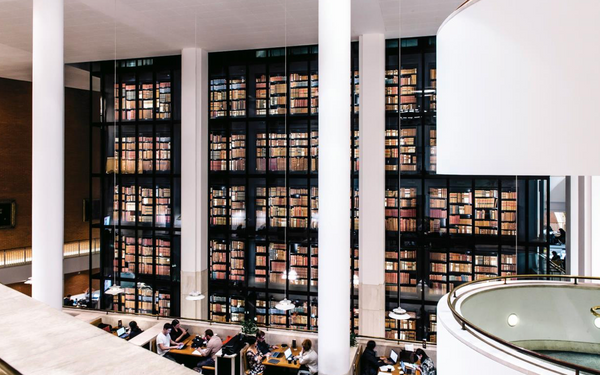
In a special message to the Library to mark the anniversary, His Majesty King Charles III said: “Since its establishment, the British Library has become one of the great libraries of the world, treasured by all who use it. The British Library continues to reach millions of people through its display of extensive collections, Reading Rooms and network of partner libraries. I am pleased to see that The King’s Library remains to this day a working part of the national collection.”
Culture Secretary Lucy Frazer said: "The British Library was one of the outstanding cultural creations of the second Elizabethan age.
"In the fifty years that followed, the Library became home to the UK's written history with an extensive collection and a heritage that has entertained and informed millions of visitors.
"As accurate and reliable information becomes ever more valuable, libraries like the British Library continue to increase in importance as one of the most trusted sources of knowledge and facts. The Library has everything to look forward to in the next 50 years."
Dame Carol Black DBE, Chair of the British Library Board, said: “Fifty years ago, the British Library was brought into being by a vision that united great heritage collections and modern day scientific research publications. Over the past five decades, as the collection has continued to grow and develop, so has the role that we serve – both as a world-class research library, and as a cultural institution that aims to be for everyone. Thanks to all of our loyal users, staff and supporters for making us everything that we are, as we look forward to our next fifty years.”
Highlights since the British Library began operations in 1973 include:
There will be a series of Pay-What-You-Can events to celebrate the 50th anniversary. The programme will comprise online and in-person events in London and Yorkshire throughout July, including:
The Library recently published a new strategic vision, Knowledge Matters, which outlines the ways in which, as the UK’s national library, it will serve new and existing audiences over the next seven years, while adapting to the monumental changes that are already impacting both the knowledge industry and the wider world.
Knowledge Matters underpins the renewal of the Library’s Boston Spa site in Yorkshire, to provide urgently needed extra space for a collection that grows by 8 kilometres of shelving each year, working towards a permanent new site in the city centre of Leeds, and expanding our the iconic London campus at St Pancras to create a brand new space for London that everyone can enjoy.
You will find both TopicUK and Yorkshire Businesswoman magazines in The British Library.